More "Colorful and Beautiful"?


Quotas have been much in the news lately. The drive to bring greater numbers of women to the World Economic Forum raised the issue once again.

The WEF goal is to have the100 corporate "strategic partners" of this year's World Economic Forum annual meeting in Davos, Switzerland – a group that includes companies like Goldman Sachs, Deutsche Bank, and News Corp.  —  bring at least one woman among their five delegates to the conference.  Did it work? Not really. According to Reuters, women made up only 16% of the 2500 delegates this year. Worse, 20 of the sponsors brought all male teams.

And now, Germany is having a conversation about quotas for women on boards (see my posts on this topic here). As stark evidence of why something has to be done, read what The Local (Germany's news in English) had to say about the Deutsche Bank head:
“I’m pleased that the Chancellor has said that she does not want a legal quota for women,” said Deutsche Bank boss Josef Ackermann, according to Handelsblatt.

Though Deutsche Bank has an all-male executive committee, he told the paper there should be more women in executive positions, adding that they made company boards “more colourful and beautiful.”
Colorful and beautiful? Really!

No wonder quotas are in the news. 40 years into the women's movement, it will require forcing women on boards and to Davos to confront antiquated attitudes like that.

UPDATE: Article 2/13 from the U.K.'s Independent.

Lead ON!
Susan
Susan Colantuono is CEO of Leading Women and author of No Ceiling, No Walls.
 Follow her on Twitter |  LittlePinkBook  |  Facebook  |  LinkedInGroup |  LinkedIn


Bookmark and Share

On Boards, Sponsors and A Different Kind of Muse

Time for another smorgasbord. 10 stories from the past few weeks - many from abroad:
  1. Why You Should Want More Women at the Top by
  2. imposing a code of practice on headhunters who recruit board-level staff, establishing a group of executives to play a counseling role for female appointees and the creation of an academy to train successful businesswomen." In a related article in the International Business Times he is quoted as saying:
    "...[we] also debated how to increase the transparency of board appointments made via a nomination committee," he noted...'There needs to be more pressure on companies to open up their recruitment process and to bring women up the ranks from within the business. Companies could be required to provide board internships to give senior staff the experience of what it means to be on a board.'"
  3. Pressure Through Publicity. Tackling the women on boards problem from a slightly different perspective, the Confederation of British Industry is recommending that, "Listed companies should be required to report diversity progress on a 'comply or explain' basis to boost the number of women in boardrooms." 
  4. Cosmetic Dentistry and Hair Dye. A recent study from Great Britain identifies the steps people will go to to attain the attractiveness they believe is necessary for career success.
  5. Focus on Sponsors. Catalyst has brought focus on the importance of having someone in your court who helped you advance. These people used to be called mentors until mentoring programs became required and this high-stakes advocacy leaked out of the mix. Now they are called "sponsors"...whether the same thing will happen with "sponsorship programs" is to be seen. Anyway, the importance of having advocates in your career corner was an important topic at the International Women's Forum in Montreal. 
  6. A Different Kind of Muse. If you've read my book, No Ceiling, No Walls, you would predict that I would love this story (another out of Great Britain) about  Karen Gill and Maxine Benson, the founders of Everywoman, who are behind a new project to encourage more young women to become business leaders - by offering up more positive role models. Helping young women look  to professional women of accomplishment as role models instead of (or in addition to) the latest celebrity, is a VERY worthy goal!
  7. Cheapening Women? A Daily Mail article on the British women on boards debate...the argument against quotas would "cheapen" women. Excuse me, but I don't think that evidence bears that out...ask the women who now comprise 40+% of board seats in Norway.
  8. Breeding Grounds for Entrepreneurs. It might surprise you (or not) that less wealthy countries have a higher rate of women-owned businesses. With 11% women entrepreneurs and 18.5% men, the U.S. comes in 16th in this list of the 20 countries with the highest percentage. #1 is Thailand! Japan has more women-owned businesses than men-owned.
  9. Closing the Gender Pay Gap. In this article for the CNN, Nancy Carter of Catalyst describes the gap and offers some actions women can take, but lets the companies off the hook. Without pay-equity audits (conducted by only a small percentage of companies), organizations are likely to continue to take the risk of a wage discrimination lawsuit as a "cost of doing business."
  10. Breaking into the G20. 4 women participated in the G20 Summit in November, the largest number ever! Attending were Christina Fernandez de Kirchner, president of Argentina; Dilma Rousseff, president-elect of Brazil; Julia Gillard, prime minister of Australia and Angela Merkel, chancellor of Germany. 
Lead ON!
Susan
Susan Colantuono is CEO of Leading Women and author of No Ceiling, No Walls.  Follow her on Twitter.

Bookmark and Share

Winning Women in Technology - and How to Get More

Recently at TED Sheryl Sandberg, COO of Facebook spoke about the importance of women staying at the table and what we can do to continue to make advances to the C-suite. Together with Carol Bartz, CEO of Yahoo, Sheryl's has been a familiar name when talking about women in technology.


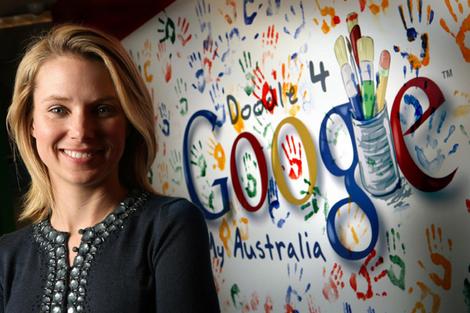
Marissa Mayer, VP of geographic and local services at Google is another familiar name. One of the first employees at Google, she talks in her Newsweek interview about women in technology, women at Google, her career and Google's commitment to diversity. Although the percentage of women at Google hovers at the meagre 15 - 17%, she says this about the commitment:
"It’s something that they’ve had to work at over time. There was one point in the early days when we had hired 16 men in a row into engineering, and Larry said, “You know what? If we get to 20, I’m not going to sign any more offer letters until you start producing an equal ratio of women.” That was the moment when we really started recruiting for technical women, helping to build programs around it, really putting a lot of effort into it. So it’s something that the founders have always been very focused on.
In addition to hiring technical women, we’ve done a lot of things here that are aimed at making it a very good place for women to work. For example, in our hiring practices we make sure there’s a woman engineer on each interview, and I think that makes a big difference in terms of how engineers relate to each other. Because there are a lot of male engineers who can only really relate to other men."
This stands out because it shows the importance of leadership at the top and concrete steps that companies can take.

Recently I spoke with a CEO of a global company about the feasibility of getting other CEOs to sign a commitment to require HR to float diverse slates of candidates for C-suite and feeder positions. She told me the story about a C-level opening at her company. HR had done the usual things - posted the opening on Monster and other sites - and she said, "not one woman applied." That didn't surprise me. Business-as-usual hasn't significantly moved the percentages of women at the top in years.

What it will take is business-not-as-usual. Actions such as Larry Page's announcement at Google that he wouldn't sign new offer letters until the gender ratio changed. The HR exec at the company that got zero applications from women could have actively sources for such an important position - and her CEO might have required a diverse slate (but didn't). What business-not-as-usual is your company taking?

Lead ON!
Susan
Susan Colantuono is CEO of Leading Women and author of No Ceiling, No Walls.  Follow her on Twitter.
Bookmark and Share

SLOW and Unsteady Progress


Catalyst released its 2010 Census and it's receiving a bit of coverage (Today online, Seek4Media, MyStateline, Reuters, LifeInc). Conventional wisdom over the summer was that business had been experiencing a "mancession" and that we were experiencing "The End of Men."  I didn't believe a word of it, but because the facts are in opposition to the new conventional wisdom, this release by Catalyst is getting more than its usual coverage. Catalyst is reporting that
136 of Fortune 500 companies had no women executives, among them Exxon Mobil, Berkshire Hathaway, Citigroup, Costco Wholesale and Sears Holding. Women held 14.4 per cent of executive officer positions in 2010, up from 13.5 per cent in 2009, and female executive officers held 7.6 per cent of the top earning positions, up from 6.3 per cent last year, the 2010 Catalyst Census showed.
"This is our fifth report where the annual change in female leadership remained flat. If this trend line represented a patient's pulse, she'd be dead," said Ms Ilene Lang, president and chief executive of Catalyst, a non-profit organisation that advocates greater opportunities for women.
The best five companies in terms of women in the executive suite were Gap, H&R Block, Limited Brands, TIAA-CREF and Western Union.
More than 10 per cent of companies lacked any women on their boards last year and this year."
What bothers me about the coverage is that Ilene Lang's rationale for getting women into leadership is not one that's likely to convince boards and C-suite men to take action. She is quoted as saying, "To be successful, they have to have more points of view - people from all kinds of backgrounds - and have diversity in the senior leadership." A different winning argument would be that companies that have gender-neutral advancement practices (more outcome-oriented versus subjective) get more women to the top which is likely to account for the correlation between women at the top and financial performance. So, uncover and remedy bias in your systems if the top of diverse organizations is mostly male.

The Catalyst census also points to the importance of having sponsors (as opposed to mentors.) Don't get me started on this subject! Women have been told to get mentors (which actually meant sponsors back when the advice started in the 70s) for nearly 4 decades. Formalizing these mentoring programs eliminated the "sponsorship" element and revisiting this to establish formal "sponsorship" programs will do the same and we'll be looking for a new word in 40 years to describe the commitment of more senior people to help more junior advance.


Jenna Goudreau picks up the Catalyst information and writes about the discrepancies in impact between women and men who have mentors. Her bottom line advice is:
"Professional women should seek out mentors at the highest levels of leadership. Those that do are promoted at the same rate as men with mentors at the top. Less clear is why women’s compensation lags behind men’s even with a mentor at the top."
But advice to get a senior mentor (or sponsor) misses the point if you don't know what to seek from the relationship.

Special Tip for You!
At Leading Women we offer unconventional advice about how women can make the most of mentoring relationships. Hint: ask for a piece of P.I.E. Want to know more about what this means and how it can fuel your career success? Email me.

A few random links:  
These two studies relate in one way: "Almost 3% of women were dismissed from their jobs, the study found, while less than 1% of their male counterparts suffered the same fate."
Lead ON!
Susan
Susan Colantuono is CEO of Leading Women and author of No Ceiling, No Walls.  Follow her on Twitter.

Who's Failing Whom?

 In a Forbes.com article, titled " Why Business Schools are Failing Women," Selena Rezvani and Sandie Taylor explain that most business schools do a poor job recruiting and addressing the needs of women. With this I wholeheartedly agree.

But within the article that I came across very disturbing information. They write, here are common questions that women ask:
"--Can I be liked and respected?
--How do I project a firm, credible presence so that I'm taken seriously?
--Can I have the job of my dreams and a family?
--How feminine can I be in this largely male environment?
--What's the best way to maneuver through a male-female power struggle?
--How can I be sure this is a gender issue for that matter?"
While these are important questions, at least if we believe what we read in women-oriented media, they do not get to the heart of women's career success. So, I'd like to offer quick (and slightly irreverent) answers and then get on to more meaty questions.

"--Can I be liked and respected? Yes
--How do I project a firm, credible presence so that I'm taken seriously? See below.
--Can I have the job of my dreams and a family? Yes, reference most of the F500 women CEOs.
--How feminine can I be in this largely male environment? Well, you can't show too much cleavage.
--What's the best way to maneuver through a male-female power struggle? Strategically.
--How can I be sure this is a gender issue for that matter?" Do you see the same thing happening to men?
4 Questions for Career Success
Answering these questions might quell concerns, but they will not help women advance. Instead, here are 4 questions that any woman could ask in order to create a career that soars™:
  1. How can I develop and demonstrate the business, strategic and financial acumen that will advance my career?
  2. How do I build and nurture the right strategic networks of people inside and outside the organization?
  3. What are the worldviews of successful leaders and how can I cultivate mine?
  4. How do the answers to these questions change as I move up?
These are certainly not the only questions that will help advance careers, but these questions will serve women at every career stage from grad school to the C-suite and onto corporate boards. You'll find more questions along with answers and tips in No Ceiling, No Walls.

More from Forbes
In the past, I've covered this in our Lead ON! newsletter, but thought it worth posting here as well. From Carol Hymowitz' blog.
"Just 28% of some 800 companies that McKinsey surveyed for its 2009 Women Matter study cited “achieving leadership diversity” among their top 10 priorities and 40% of the companies surveyed said “it wasn’t a priority at all,” Barsh said.
The study also found that women and men have very different views about what’s needed to achieve gender parity in leadership ranks. Some 70% of the female leaders who were surveyed said they thought women needed to hold at least 30% of senior posts in business, government and elsewhere to be taken seriously and to influence decision making. But a majority of male leaders surveyed didn’t think having a critical mass of women in senior roles mattered. (Barsh agreed with the women’s perspective.)
Moreover, many companies “mistakenly think if they offer women flexible work schedules (so they can more easily balance childrearing and jobs) they’ve done enough,” said Barsh. But companies also need to analyze and improve how they developing, paying and retaining women."
And Davia Temin covered the Harvard Kennedy School's Women and Public Policy program, and co-sponsored by the Council of Women World Leaders and the World Economic Forum (Davos). She lists these findings:

  • "The more complex the issue, the more diversity improves the correct outcomes of decision-making.
  • Quotas do work! In India, where there are gender quotas for female chief councilors in the villages, strong evidence shows that "villagers who have never been required to have a female leader prefer male leaders and perceive female leaders as less effective than their male counterparts," even when performance is identical, according to MIT professor Esther Duflo. But "exposure to a female leader ... weakens stereotypes about gender roles ... and eliminates the negative bias in how female leaders' effectiveness is perceived among male villagers. ...
  • There is a strong correlation around the world between gender inequity and poverty: The greater the gender inequity, the greater the poverty.
The overwhelming conclusion of the conference was that the time is uniquely right--the time is now--to make significant impact through a combination of hard data and measurement, case studies and advocacy. Closing the gender gap is, as Bohnet stated, not only a human rights issue, it is a verifiable business imperative for our society's well-being."
To find out what's happening at the Kennedy School go here.

Lead ON!
Susan
Susan Colantuono is CEO of Leading Women and author of No Ceiling, No Walls.  Follow her on Twitter.

2 Steps Back and 1 Step Forward


Since last month when I signed Vision 2020's Declaration of Equality (please go and sign it here: http://www.drexel.edu/vision2020/get_involved/declaration/ ) the Senate failed to pass the Paycheck Fairness Act because the entire republican block including Olympia Snowe and Susan Collins voted against it. That's the 2 steps back.

Now, for the 1 step forward - this week as reported in the Iowa Independent,
"U.S. Sen. Dick Durbin (D-Ill.) called for testimony on a more than 30-year-old United Nation’s treaty — one that was signed by President Jimmy Carter in 1980 but has never been brought to the floor of the U.S. Senate for an up-or-down vote. The treaty, known as the Convention on the Elimination of all forms of Discrimination Against Women, or CEDAW, has been called an international bill of rights for women and has been ratified by all but seven countries. In addition to the U.S., other hold-out countries include Sudan, Iran, Somalia and three small Pacific Island nations.


“CEDAW is about giving women all over the world the chance to enjoy the same freedoms and opportunities that American women have struggled long and hard to achieve,” explained Durbin, who led the CEDAW hearing as part of the Senate Judiciary Subcommittee on Human Rights and Law. “These are fundamentally American freedoms — the rights to life, liberty and the pursuit of happiness — and CEDAW is a fundamentally American treaty. Women have been waiting for 30 years. It’s long past time for the U.S. to ratify this treaty and we should do so without further delay.”
Unfortunately, instead of highlighting the very real challenges that are faced daily by women in the U.S., Durbin instead closed his call with this:

“The U.S. does not need to ratify CEDAW to protect the rights of American women and girls,” concluded Durbin. “While more progress is needed, women have fought long and hard for equal rights in the U.S. and have won many victories along the way. … American women have rights and freedoms that far exceed those required under CEDAW — and ratifying the treaty would not change current U.S. law in any way. The United States ought to ratify the treaty to ensure our dedication to the protection of human rights around the world isn’t questioned.”
And, if that's the perspective needed to get the U.S. to ratify thereby separating itself from the Sudan, Iran and Somalia on this issue, so be it, but Michelle Chen aptly points out in a Huff Post editorial that ratification could cause headaches for our legislators on two provisions of Article 11:
"(d) The right to equal remuneration, including benefits, and to equal treatment in respect of work of equal value, as well as equality of treatment in the evaluation of the quality of work;
(e) The right to social security, particularly in cases of retirement, unemployment, sickness, invalidity and old age and other incapacity to work, as well as the right to paid leave"
If you care about legal protection for the gains we've made and further action on the family-friendly policies that study after study says are important for women's continued gains in the workplace, consider a call to your senator on this issue.

Lead ON!
Susan
Susan Colantuono is CEO of Leading Women and author of No Ceiling, No Walls.  Follow her on Twitter.

Bookmark and Share

Personal Brand > Professional Brand > Leadership Brand


This morning I commented on the ForbesWoman LinkedIn group to a discussion on personal branding. The question was, "are businesswomen avoiding the spotlight, not as focused on Personal Branding as men?" Here's my response:
"My research confirms that women are less likely to seek the spotlight and develop a professional brand by displaying expertise in many arenas. For example, in several gender-neutral LinkedIn groups on leadership, the comments are overwhelmingly offered by men. Another, a review a few years ago of HBR articles showed that nearly all were written by men.

That being said, I wouldn't say that women are not as focused on our Personal brands. We are mis-focused. Here's why: most messages we receive about personal branding are over-focused on personal style: attire, fitness, accessories. This mis-focus on style is coupled with women's humility and distaste for or discomfort with self-promotion. As a result we often don't look for or take advantage of opportunities to establish professional competence and leadership credibility."
This was a timely question. Yesterday I presented to the WISE group at New York Life. One of the most important pieces of advice I offered was that there is a difference between your personal, professional and leadership brands. This is a distinction rarely made, but absolutely essential for women who are working to create careers that soar or businesses that succeed.

If you'd like to learn more about the distinction and how to make it work for you, please email info@LeadingWomen.biz.

Lead ON!
Susan
Susan Colantuono is CEO of Leading Women and author of No Ceiling, No Walls.  Follow her on Twitter.
Bookmark and Share