Showing posts with label Jenna Goudreau. Show all posts

SLOW and Unsteady Progress


Catalyst released its 2010 Census and it's receiving a bit of coverage (Today online, Seek4Media, MyStateline, Reuters, LifeInc). Conventional wisdom over the summer was that business had been experiencing a "mancession" and that we were experiencing "The End of Men."  I didn't believe a word of it, but because the facts are in opposition to the new conventional wisdom, this release by Catalyst is getting more than its usual coverage. Catalyst is reporting that
136 of Fortune 500 companies had no women executives, among them Exxon Mobil, Berkshire Hathaway, Citigroup, Costco Wholesale and Sears Holding. Women held 14.4 per cent of executive officer positions in 2010, up from 13.5 per cent in 2009, and female executive officers held 7.6 per cent of the top earning positions, up from 6.3 per cent last year, the 2010 Catalyst Census showed.
"This is our fifth report where the annual change in female leadership remained flat. If this trend line represented a patient's pulse, she'd be dead," said Ms Ilene Lang, president and chief executive of Catalyst, a non-profit organisation that advocates greater opportunities for women.
The best five companies in terms of women in the executive suite were Gap, H&R Block, Limited Brands, TIAA-CREF and Western Union.
More than 10 per cent of companies lacked any women on their boards last year and this year."
What bothers me about the coverage is that Ilene Lang's rationale for getting women into leadership is not one that's likely to convince boards and C-suite men to take action. She is quoted as saying, "To be successful, they have to have more points of view - people from all kinds of backgrounds - and have diversity in the senior leadership." A different winning argument would be that companies that have gender-neutral advancement practices (more outcome-oriented versus subjective) get more women to the top which is likely to account for the correlation between women at the top and financial performance. So, uncover and remedy bias in your systems if the top of diverse organizations is mostly male.

The Catalyst census also points to the importance of having sponsors (as opposed to mentors.) Don't get me started on this subject! Women have been told to get mentors (which actually meant sponsors back when the advice started in the 70s) for nearly 4 decades. Formalizing these mentoring programs eliminated the "sponsorship" element and revisiting this to establish formal "sponsorship" programs will do the same and we'll be looking for a new word in 40 years to describe the commitment of more senior people to help more junior advance.


Jenna Goudreau picks up the Catalyst information and writes about the discrepancies in impact between women and men who have mentors. Her bottom line advice is:
"Professional women should seek out mentors at the highest levels of leadership. Those that do are promoted at the same rate as men with mentors at the top. Less clear is why women’s compensation lags behind men’s even with a mentor at the top."
But advice to get a senior mentor (or sponsor) misses the point if you don't know what to seek from the relationship.

Special Tip for You!
At Leading Women we offer unconventional advice about how women can make the most of mentoring relationships. Hint: ask for a piece of P.I.E. Want to know more about what this means and how it can fuel your career success? Email me.

A few random links:  
These two studies relate in one way: "Almost 3% of women were dismissed from their jobs, the study found, while less than 1% of their male counterparts suffered the same fate."
Lead ON!
Susan
Susan Colantuono is CEO of Leading Women and author of No Ceiling, No Walls.  Follow her on Twitter.

A Compendium of News

Going, g o i n g, g o n e
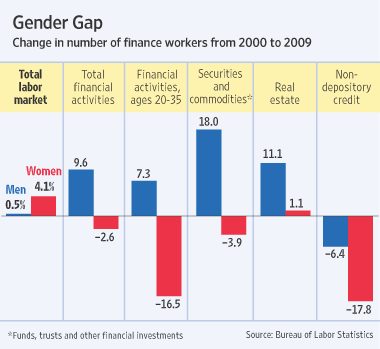
WSJ reports that women are leaving financial institutions at a rate far greater than their male counterparts (see above).
"In the past 10 years, 141,000 women, or 2.6% of female workers in finance, left the industry. The ranks of men grew by 389,000 in that period, or 9.6%, according to a review of data provided by the federal Bureau of Labor Statistics.
The shift runs counter to changes in the overall work force. The number of women in the U.S. labor market has grown by 4.1% in the past decade, outpacing a 0.5% increase in male workers.
The difference is pronounced at brokerage firms, investment banks and asset-management companies."
Thanks to Francesca for the heads up on this story.

Thumbs Up... Thumbs Down
As part of the Clinton Global Initiative, Coca Cola has committed to have women represent 50% of their micro-distribution centers (basically individual entrepreneurs who distribute product to retailers). While this is great news on one level, my trip to Guatemala in June was evidence of two dangers from American beverage companies: an overabundance of waste in developing countries without the infrastructure to handle it and the very sad feeding of cola products to infants.

Let's Hear it for the Swiss!
For the first time, Switzerland has more women in its cabinet than men. This a mere 40 years after women gaining the right to vote. Now, why is U.S. so far behind after nearly 100 years?
"The four-three majority makes Switzerland only the fourth country in the world to have more women than men in its cabinet, according to the Inter-Parliamentary Union. The others are Cape Verde, Finland, and Norway."
Vision 2020
Speaking of 100 years of women's suffrage...Next month is the first meeting of Vision 2020, a decade-long initiative to advance women's equality in advance of the 100th anniversary of women's sufferage. I am honored to be one of the delegates from RI and look forward to the first meeting next month. Please reach out to your state's delegates and ask what you can do to make change.

And speaking of what's left to be done. Here's what Jenna Goudreau of ForbesWoman has to say.
"In 2010, women are legally able to achieve equal footing. But have they? They are now half of the workforce, but earn only 78% as much as men. They earn the majority of bachelors and masters degrees, but are still more likely to serve as primary parent and housekeeper for the family. We came close to a female president but haven’t had one. Meanwhile Ireland, India, Costa Rica and Liberia have elected a female leader. Women are 51% of management and professional workers, yet in the largest companies in the U.S. only 3% have female CEOs and only 16% of board members are women. For the first time in history, we have three female Supreme Court justices. Time to celebrate? Only 17% of Congress members are women, and only six of the nation’s 50 governors are women."
More on the "Glass Cliff"
In 2004, the term "glass cliff" was coined to describe women who are placed in leadership positions in organizations in precarious financial situations. Summarized in the British Psychological Society's Research Blog, the study by Susanne Bruckmüller and Nyla Branscombe finds:
"...the phenomenon occurs firstly, because a crisis shifts people's stereotyped view of what makes for an ideal leader, and secondly, because men generally don't fit that stereotype. '...[I]t may not be so important for the glass cliff that women are stereotypically seen as possessing more of the attributes that matter in times of crisis,' the researchers wrote, 'but rather that men are seen as lacking these attributes ...'."
That's Dr. Ms....
For the first time ever women earned the majority (50.4%) of doctoral degrees awarded in 2008-09. Most in public administration, health sciences and education.

Women continue to lag behind in mathematics, computer sciences, physical sciences (all <30%), style="font-weight: bold;">Going, going, g o n e?
Women in financial institutions are disappearing, well relatively speaking. (See graph above)
"In the past 10 years, 141,000 women, or 2.6% of female workers in finance, left the industry. The ranks of men grew by 389,000 in that period, or 9.6%, according to a review of data provided by the federal Bureau of Labor Statistics.
The shift runs counter to changes in the overall work force. The number of women in the U.S. labor market has grown by 4.1% in the past decade, outpacing a 0.5% increase in male workers.
The difference is pronounced at brokerage firms, investment banks and asset-management companies."
Goldman Sachs in the Crosshairs
Once again a financial institution has been sued for gender discrimination. If it goes the way of Morgan Stanley, it could come at a substantial cost. Morgan Stanley paid out a $54million award.
"Wall Street doesn't get it," said Kelly Dermody, a partner at Lieff Cabraser Heimann & Bernstein LLP representing the plaintiffs.
"Even as some (women) do crack the glass ceiling, Wall Street continues to pay them less, relegate them to jobs that have less upside potential, and exclude them from important clients and business opportunities," she added."
Lead ON!
Susan
Susan Colantuono is CEO of Leading Women and author of No Ceiling, No Walls. She blogs on networking for PINK Magazine. Follow her on Twitter.
Bookmark and Share