Showing posts with label statistics. Show all posts

The Power of Women's Leadership

Guest blog by Renee' Aloisio and Kate Kennedy. As one of the state delegates to Vision 2020, I have enjoyed working with them and the other amazing women who are part of this effort. Thanks to GoLocal for the original.

As the Rhode Island economy plods along its slow recovery, our state's businesses continue to seek out any kind of competitive advantages to get ahead. One such advantage that has been widely documented and reported is the power of women's leadership. Some companies are making serious investments in this area, while others have yet to take full advantage of the opportunity.

Research indicates companies led by women or with a higher representation of women board directors experience higher financial performance. The correlations are found across industries ‒ from consumer discretionary to information technology. Here in Rhode Island, women currently make up 48% of the workforce, and many women can be found in entry- and mid-level management positions. But when we look at the top levels of management, executive officers hover at somewhere just above 10% and board seats are filled by a slim 16%. A clear indication that we can and should be doing better.
Vision 2020 Rhode Island's upcoming report, Women, Leadership and Wages, reviews the findings of a survey conducted with 22 of the state's largest not-for and for-profit businesses. The survey is focused on initiatives and best practices that advance women, such as commitment to women’s leadership, advancement of women into senior leadership, wage equity and women on boards. The report also examines obstacles and barriers to advancing women into leadership.

The findings at times fall below where we would hope Rhode Island businesses could be: for example, only 23% of for-profits and 1% of not-for-profits surveyed have a clearly defined strategy and philosophy for the development of women into leadership roles. However, some best practices are being utilized to advance women, such as requiring a diverse slate of candidates for executive searches and conducting wage equity audits that look for inequities in compensation between men and women serving in the same position. This report can and should be used by for-profit and not-for-profit leadership teams, human resource departments and board of directors to spearhead meaningful conversations for improving the advancement of women in their organizations' leadership team. The real benefits of paying attention to these measures ‒ short and long-term, financial and workforce ‒ can offer an alternative for contributing to companies' competitive positions and thus Rhode Island's economic growth.

On behalf of Vision 2020 RI's Corporate Sub-committee, we invite members of the business sector and other interested parties to attend and hear more about the report's findings at Leading Women's breakfast, The State of Women's Success, being held on September 11th at 8:00 at the Crowne Plaza in Warwick. We appreciate the willingness of companies who participated in the survey, and we urge all members of the business community to participate in ongoing research to share successes and challenges in advancing women's leadership as we work together to advance Rhode Island's economy.
Vision 2020 was developed by the Institute for Women's Health and Leadership at Drexel University College of Medicine to make equality a national priority through shared leadership among women and men. The organization’s goal is to advance women’s equality before the landmark 100th anniversary of women’s suffrage.

Renee Aloisio is Director of Internal Operations at LGC&D and Kate Kennedy is the Executive Director of Rhode Island Business Group on Health.

The report, Women, Leadership and Wages will be available online at www.leadingwomen.biz and at www.wfri.org on September 11. Hard copies will be distributed at the event.

Lead ON!
Susan   
Susan Colantuono is CEO of Leading Women and author of No Ceiling, No Walls and Make the Most of Mentoring. Follow her on TwitterLittlePinkBook  |  Facebook  |  Google+  |  LinkedInGroupLinkedIn

New Zealand Ahead...and Yet So Far to Go

During my recent trip to New Zealand, Jennifer, a senior HR executive said, “The U.S. is definitely ahead of where we are as far as women in senior leadership and business." And her comment is typical. Not long ago the NZ Census of Women’s Participation wrote,
"The corporate sector remains an embarrassment for New Zealand in terms of diversity of governance, at a time when women are increasingly consumers, customers, clients, employers, employees and investors," the report says…It is perplexing that boardroom doors are shut to women at a time when global business requires transformation."
When I talked with businesswomen in New Zealand they told me that women in the U.S. are ahead of them in terms of access to senior positions. This raised for me this interesting question, how did the country that was first in giving women the vote not rocket ahead on women in business? It’s especially intriguing because the nation has twice elected women to the position of prime minister.

Through the efforts of Kate Sheppard (image above), New Zealand became the first self-governing country to give women the vote. It happened in 1893!  Approximately 100 years later, the nation was led by two women - from 1997 when Jennifer Mary Shipley was elected as Prime Minister until November 2008 when Helen Clark stepped down. In the early 21st century New Zealand women have held other of the country’s key constitutional positions: governor-general, speaker of the House of Representatives, attorney-general and chief justice.

Today, the idea that women could not or should not be active in government is completely foreign to New Zealanders. In 2012, 32% of Members of Parliament are female, compared with 17% in today’s U.S. congress.

While they're far ahead of the U.S. in political representation, only 9.3% of companies listed on the NZX have women on their boards. That’s not the percentage of women on boards, it’s the percent of companies with women on their boards! 

As a contrast, nearly 85% of FORTUNE companies have women on their boards. A group of women (25%) and men who are high level corporate leaders have banded together in a bid to increase this number to 25 per cent by the end of 2015.

Women in each country have much to teach and much to learn about representation in positions of power.

Lead ON!
Susan
Susan Colantuono is CEO of Leading Women and author of No Ceiling, No Walls and Make the Most of Mentoring.
Follow her on TwitterLittlePinkBook  |  Facebook  |  Google+  |  LinkedInGroupLinkedIn

Don't Grow Complacent - HBR Report Is Not As Good as it Seems!

While I was in Guatemala for our Leadership in Action program many of you sent me links to the Harvard Business Review blog asking: Are Women Better Leaders than Men? The authors' assertions are that in an analysis of their 360 feedback reports of over 7000 managers, women were rated as outperforming men in nearly all of them - actually 12 out of 16. BUT hold on a minute! There are 2 major failings in their research.

Let's use my definition of leadership to analyze the competencies they measure. "Leadership is using the greatness in you to achieve and sustain extraordinary outcomes by engaging the greatness in others." And note that our research indicates that when directors executives talk about the desirable skills for C-suite candidates and high potentials, 50% of the skills relate to achieving outcomes. These include skills related to business, strategic and financial acumen.

Here's how the reported competencies in the Folkman/Zenger study array.
  • Use the greatness in you: about 5/16
  • Achieve outcomes: about 5/16 (We were generous here! It could have been fewer.)
  • Engage others: about 6/16
As with nearly all the competency models we've analyzed, we see a disproportionate lack of emphasis on business, strategic and financial acumen (31%).

Another limitation of their research is that they aggregated the feedback from each manager's boss, peers and direct reports. This does nothing to explain why (as I've asked for years) if women are so good, why are so few of us at the top. Peers and direct reports have a limited impact on a manager's advancement. It's the opinion of the boss and others above the manager that weigh heavily an advancement decisions.

Given these concerns, here is the comment I left:
In the final analysis, advancement depends heavily on the perceptions of a candidate's boss and other higher level managers - especially perceptions about key business, strategic and financial skills. Both the importance of business, strategic and financial acumen and the impact of the boss appear to be understated. The the feedback of boss, peers and direct reports has been rolled together (or so the blog implies). Also, there is a significant under-representation of business, strategic and financial skills.

We'd be interested in knowing how the stats look if you report only the perceptions of people ABOVE the rated managers. There have been many studies where men and women are rated as fairly equal UNTIL the researchers examined only the boss' perceptions.


And what do you find on skills related to what we call The Missing 33%™?  Or, as our research indicates, are key business, strategic and financial skills under-measured in the evals. We've found that this is a significant pattern in Fortune 500 companies and accounts for a serious embedded gender bias that disadvantages women.

http://www.leadingwomen.biz/displaycommon.cfm?an=1&subarticlenbr=379
Don't be fooled by their report. Don't become complacent. You can't afford to believe that what companies measure formally is what helps women progress. And you can't believe that because studies like these show that women are perceived as "better leaders than men" those perceptions will serve to buoy your career.

Lead ON!
Susan
Susan Colantuono is CEO of Leading Women and author of No Ceiling, No Walls and Make the Most of Mentoring.
Follow her on TwitterLittlePinkBook  |  Facebook  |  Google+  |  LinkedInGroupLinkedIn

Reflections on the 100th Anniversary International Women's Day


March 8th is the 100th anniversary of International Women's Day and I am spending it with the Global Women's Council of a F500 company. For me this is a fitting way to celebrate both the accomplishments and highlight the steps yet to take in corporate America - the women in the room have made it close to the top of this venerable company, and yet in all its history it has never had a woman CEO.

That said, I'd like to take this opportunity to cast a wider eye at what's happening to women around the world. Starting here in the US, last week the White House issued its first report on the status of women in 50 years. While the media overplayed the wage gap, there is a related factor that has worsened, the rate of women living in poverty. 

As displayed in the Huffington Post, in spite of incredible leaps forward in level of education attained, 18% of women overall and nearly 40% of women heads of households live below the poverty level. In looking carefully at the graph, I noticed something disturbing.
  • Both percentages were on an overall downward trend from 1964 to 1979.
  • They rose during the Reagan years and stayed relatively high until around 1993 when Bill Clinton took office. During his presidency (1993 - 2001), the rates declined.
  • During George W. Bush's tenure women's poverty levels increased again. 
Now, most of you know that I don't like to be political in this column, but the correlation between the policies of conservative Republicans and the worsening status of women have been on my mind given the many recent initiatives at the state and federal level to curtail women's reproductive rights. As I can attest from personal experience - access to family planning resources and reproductive rights are the foundation for women's health and economic well-being. But this is not simply a personal experience for many women who have had the luxury of planning their pregnancies. This is also one of the factors cited in a Federal Reserve Bank of Boston report on the progress made by women in business. And yet, our rights in this area are under the deepest attack in decades.

Federally, the revised H.R.3 would deny tax credits to businesses that offer employees health insurance plans that happen to cover abortion care, as well as disallow any medical deductions for expenses related to abortion. Women would not be able to set aside their own money in pre-tax health accounts for abortion coverage (hmmm, I wonder if their male partners could. So much for small government. You'd need an army to police the health policies of every company applying for tax credits and Health Savings Accounts of every woman!)

Several years ago two women - one anti-choice and one pro-choice - co-authored a book on reproductive rights. Though they had different perspectives on abortions, they found common ground when it came to preventing unwanted pregnancies. Shocking to the anti-choice author were the attacks she endured for her pro-contraception stance. Hearing them interviewed was the first time that I learned that the anti-choice movement is using abortion for a broader anti-contraception agenda.

This face of the anti-choice movement has been revealed again this month. For example, in Wisconsin the governor's budget would not only defund Planned Parenthood, it would reverse a state law that requires health insurers to pay for prescribed contraceptives. (No mention is made about whether he would reverse reimbursements for Viagra!)

Conservatism and religious fundamentalism are the foundation of these movements and both are on the rise not only in the U.S., but also around the globe - primarily in Muslim countries where unrelenting pressure is forcing women out of the mainstream and into the shadows. In emerging economies - as reported in Half the Sky - women and girls continue to suffer from sex trafficking and forced prostitution; gender-based violence including honor killings and mass rape and maternal mortality, which needlessly claims one woman a minute. But in the marvelous book by the same title, there is story after story of women who bravely take the lead to tackle these brutal issues.

So, here's to International Women's Day and Women's History Month. We've come a long way, but we and our sisters around the world still have a long way to go. Please get active, take the lead and make a little history to help women continue to make strides in health & safety, education and economic participation.

Lead ON!
Susan
Susan Colantuono is CEO of Leading Women and author of No Ceiling, No Walls.
Follow her on TwitterLittlePinkBook  |  Facebook  |  LinkedInGroupLinkedIn

Winning Women in Technology - and How to Get More

Recently at TED Sheryl Sandberg, COO of Facebook spoke about the importance of women staying at the table and what we can do to continue to make advances to the C-suite. Together with Carol Bartz, CEO of Yahoo, Sheryl's has been a familiar name when talking about women in technology.


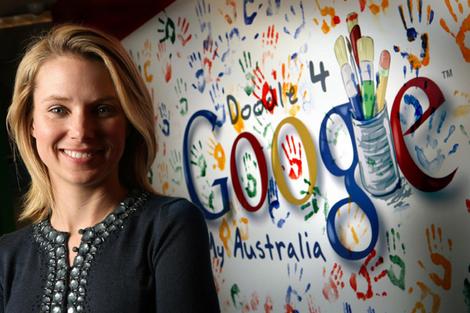
Marissa Mayer, VP of geographic and local services at Google is another familiar name. One of the first employees at Google, she talks in her Newsweek interview about women in technology, women at Google, her career and Google's commitment to diversity. Although the percentage of women at Google hovers at the meagre 15 - 17%, she says this about the commitment:
"It’s something that they’ve had to work at over time. There was one point in the early days when we had hired 16 men in a row into engineering, and Larry said, “You know what? If we get to 20, I’m not going to sign any more offer letters until you start producing an equal ratio of women.” That was the moment when we really started recruiting for technical women, helping to build programs around it, really putting a lot of effort into it. So it’s something that the founders have always been very focused on.
In addition to hiring technical women, we’ve done a lot of things here that are aimed at making it a very good place for women to work. For example, in our hiring practices we make sure there’s a woman engineer on each interview, and I think that makes a big difference in terms of how engineers relate to each other. Because there are a lot of male engineers who can only really relate to other men."
This stands out because it shows the importance of leadership at the top and concrete steps that companies can take.

Recently I spoke with a CEO of a global company about the feasibility of getting other CEOs to sign a commitment to require HR to float diverse slates of candidates for C-suite and feeder positions. She told me the story about a C-level opening at her company. HR had done the usual things - posted the opening on Monster and other sites - and she said, "not one woman applied." That didn't surprise me. Business-as-usual hasn't significantly moved the percentages of women at the top in years.

What it will take is business-not-as-usual. Actions such as Larry Page's announcement at Google that he wouldn't sign new offer letters until the gender ratio changed. The HR exec at the company that got zero applications from women could have actively sources for such an important position - and her CEO might have required a diverse slate (but didn't). What business-not-as-usual is your company taking?

Lead ON!
Susan
Susan Colantuono is CEO of Leading Women and author of No Ceiling, No Walls.  Follow her on Twitter.
Bookmark and Share

SLOW and Unsteady Progress


Catalyst released its 2010 Census and it's receiving a bit of coverage (Today online, Seek4Media, MyStateline, Reuters, LifeInc). Conventional wisdom over the summer was that business had been experiencing a "mancession" and that we were experiencing "The End of Men."  I didn't believe a word of it, but because the facts are in opposition to the new conventional wisdom, this release by Catalyst is getting more than its usual coverage. Catalyst is reporting that
136 of Fortune 500 companies had no women executives, among them Exxon Mobil, Berkshire Hathaway, Citigroup, Costco Wholesale and Sears Holding. Women held 14.4 per cent of executive officer positions in 2010, up from 13.5 per cent in 2009, and female executive officers held 7.6 per cent of the top earning positions, up from 6.3 per cent last year, the 2010 Catalyst Census showed.
"This is our fifth report where the annual change in female leadership remained flat. If this trend line represented a patient's pulse, she'd be dead," said Ms Ilene Lang, president and chief executive of Catalyst, a non-profit organisation that advocates greater opportunities for women.
The best five companies in terms of women in the executive suite were Gap, H&R Block, Limited Brands, TIAA-CREF and Western Union.
More than 10 per cent of companies lacked any women on their boards last year and this year."
What bothers me about the coverage is that Ilene Lang's rationale for getting women into leadership is not one that's likely to convince boards and C-suite men to take action. She is quoted as saying, "To be successful, they have to have more points of view - people from all kinds of backgrounds - and have diversity in the senior leadership." A different winning argument would be that companies that have gender-neutral advancement practices (more outcome-oriented versus subjective) get more women to the top which is likely to account for the correlation between women at the top and financial performance. So, uncover and remedy bias in your systems if the top of diverse organizations is mostly male.

The Catalyst census also points to the importance of having sponsors (as opposed to mentors.) Don't get me started on this subject! Women have been told to get mentors (which actually meant sponsors back when the advice started in the 70s) for nearly 4 decades. Formalizing these mentoring programs eliminated the "sponsorship" element and revisiting this to establish formal "sponsorship" programs will do the same and we'll be looking for a new word in 40 years to describe the commitment of more senior people to help more junior advance.


Jenna Goudreau picks up the Catalyst information and writes about the discrepancies in impact between women and men who have mentors. Her bottom line advice is:
"Professional women should seek out mentors at the highest levels of leadership. Those that do are promoted at the same rate as men with mentors at the top. Less clear is why women’s compensation lags behind men’s even with a mentor at the top."
But advice to get a senior mentor (or sponsor) misses the point if you don't know what to seek from the relationship.

Special Tip for You!
At Leading Women we offer unconventional advice about how women can make the most of mentoring relationships. Hint: ask for a piece of P.I.E. Want to know more about what this means and how it can fuel your career success? Email me.

A few random links:  
These two studies relate in one way: "Almost 3% of women were dismissed from their jobs, the study found, while less than 1% of their male counterparts suffered the same fate."
Lead ON!
Susan
Susan Colantuono is CEO of Leading Women and author of No Ceiling, No Walls.  Follow her on Twitter.

A Smorgasbord of News from Around the Country...and Globe


News from our Kiwi Friends...

In its Census of Women's Participation, published today, the Human Rights Commission outlines where women are losing past gains, and is particularly critical of private companies.
"The corporate sector remains an embarrassment for New Zealand in terms of diversity of governance, at a time when women are increasingly consumers, customers, clients, employers, employees and investors," the report says.
It is perplexing that boardroom doors are shut to women at a time when global business requires transformation."
 And from the U.K.
"According to Beverley Skeggs, professor at Goldsmiths, University of London, the gender pay gap between graduates is not improving. ' are much less likely to get equivalent jobs, they are less likely to be promoted as quickly so there is absolutely phenomenal gender inequality in our society that hasn't been addressed," she remarked."
Exec Women Fired More...Choose Departures More
I tried to read the original report, but the best I could do was find an article in Time that had some meat about it and the Oregon State Universtity news release.
"Women executives  are more likely to be asked to leave than men (2.9% versus 0.9 %), plus more likely to leave on their own accord (4.3% versus 2.8 %), says the study, which was conducted analyzing Standard & Poor's information on 1,500 firms, and was published in October's issue of Economic Inquiry. "The evidence suggests that women are being drawn out and forced out at higher rates. However, we don't see too much evidence of a systematic pattern in the types of firms that are forcing or having women drawn out," says lead author John Becker-Blease, an assistant professor of finance at Oregon State University. 'So, in a sense, it seems the playing field is uniformly tilted against women across firms.'"

Here's an interesting related statistic:  
Globally, senior male executives (75 percent of them) usually have a stay-at-home partner, while 74 percent of senior women executives have a partner who works full time.

Encountering Gender Fatigue
I've thought a lot about this as I've worked with F500 corporations this year. I see, especially in young women and many men in leadership, a belief that gender is no longer an issue in advancement decisions. This in spite of ample evidence to the contrary. HR execs who report statements such as, "she wouldn't want that position because she has a family" (so she's not even offered an opportunity to consider it) or who report that out of 40 or more managers viewed as high potential successors for executive positions none are women. And so I was pleased to come across the term "gender fatigue" in this Washington Post article by Selena Razvani.
"Others see gender discrimination as the reason why we're not experiencing change. Elisabeth Kelan, a scholar on gender in organizations, notes the shifting appearance of this workplace inequity. "The nature of gender discrimination has changed, moving from being blatant to being more subtle. The latter is much harder to detect and act upon. This does not mean that blatant gender discrimination has gone away―but subtle forms of gender discrimination are very common experiences in the workplace today, yet rarely expressed as such."
The phenomenon Kelan describes is called "gender fatigue," a state where people, as a default, tend to perceive their workplaces as gender neutral. Gender discrimination is seen as happening elsewhere or as incidents of the past that would not happen today. Most people don't want to believe that they work in and support a discriminatory workplace (or that they themselves discriminate), so they justify and rationalize that the discrimination doesn't exist.
I contend that the bystander effect is also at play. The more people there are in a given situation, the more we diffuse responsibility and assume "someone else will handle it." Many people know that gender inclusion is an issue, but think it's someone else's job or that another person is tackling it. Building on this observation, Bain & Company, along with Harvard Business Review, conducted a survey early this year that highlighted the levels of interest in parity work. They found that more than 70 percent of employees believe gender parity programs are failing. However, 84 percent of women surveyed believe that gender parity should be a strategic imperative for their company; while only 48 percent of men agree."
That's a lot of food for thought!

Lead ON!
Susan
Susan Colantuono is CEO of Leading Women and author of No Ceiling, No Walls.  Follow her on Twitter.

Bookmark and Share

Keeping an Eye on Progress

This week, the Calvert Group, a socially responsible mutual fund, released a study of the Corporate Diversity Practices of the S&P 100 companies and the findings are mixed. While some of the companies -  are doing very well, others fall short.
"We are very concerned about the fact that women and minorities continue to be underrepresented at the highest levels of management," says Calvert Group President and CEO Barbara J. Krumsiek of the study. "Without a pipeline of female and minority executives in highly paid, highly responsible positions, it will be very difficult to achieve board diversity, which is critical to strong governance and good management."
We congratulate the companies that scored 80% or higher - including several of our clients: Johnson & Johnson, Campbell Soup, AT&T, Pfizer, PepsiCo, CVS Caremark and Bank of America. It's an honor to be working with these innovative companies.

And we encourage those scoring lower to continue their efforts to create cultures that enable diverse talent to rise to the top.

On another note:


Lead ON!
Susan
Susan Colantuono is CEO of Leading Women and author of No Ceiling, No Walls.  Follow her on Twitter.

Bookmark and Share

More Women = Better Decisons!

In a surprising twist when analyzing a study on collective intelligence, researchers found that
"...the number of women in a group had significant predictive power. “We didn’t design this study to focus on the gender effect,” Malone said. “That was a surprise to us.” One implication is that the level of collective intelligence should keep rising along with the proportion of women in a group. To be sure, as Malone said, that gender effect is a generalization. “Of course some males have more social skill or social sensitivity than females,” Malone acknowledged. “What our results indicate is that people with social skills are good for a group — whether they are male or female.”
 There has been controversy about whether diverse groups are more effective than homogenous groups - diverse groups tend to have more conflict, but this study seems to put that issue to rest.
"“We did not know if groups would show a general cognitive ability across tasks,” said Thomas W. Malone, the Patrick J. McGovern Professor of Management at the MIT Sloan School of Management, one of the authors of the paper. “But we found that there is a general effectiveness, a group collective intelligence, which predicts a group’s performance in a lot of situations.”

That effectiveness, the researchers believe, stems from how well the group works together. Groups whose members had higher levels of “social sensitivity” — the willingness of the group to let all its members take turns and apply their skills to a given challenge — were more collectively intelligent. “Social sensitivity has to do with how well group members perceive each other’s emotions,” said Malone. “In groups where one person dominated, the group was less intelligent than in groups where the conversational turns were more evenly distributed.” Teams containing more women demonstrated greater social sensitivity and in turn collective intelligence, compared to teams containing fewer women.

When ‘groupthink’ is good

To arrive at their conclusions, the researchers conducted two studies in which 699 people were placed in groups of two to five and worked on tasks that ranged from visual puzzles to negotiations, brainstorming, games and complex rule-based design assignments. The researchers concluded that a group’s collective intelligence accounted for about 30 to 40 percent of the variation in performance.

Moreover, the researchers found that the performances of groups were not primarily due to the individual abilities of the group members."
Lead ON!
Susan
Susan Colantuono is CEO of Leading Women and author of No Ceiling, No Walls.  Follow her on Twitter.

Bookmark and Share

Wage Gap and Lipstick (Yes, Indulge Me)

$$Wage Gap$$
According to the census bureau (and as reported by USA Today) the wage gap between women and men is smaller than it has ever been. But is this good news? I'd say not. The reason is that so many men have lost good-paying jobs...jobs that might never return.

Here's how related trends break down:
"Women have held their own or increased dominance in the skilled health care trades — nurses, physical therapists, lab technicians — that are growing in employment. Nine of every 10 nurses are women — same as a decade ago.
Men have increased dominance in the industrial and construction trades such as sheet metal workers, printing press operators and roofers, but those jobs are declining in numbers. The computer business — programmers, operators, hardware engineers — is the only part of the modern economy in which men outpaced women in the past decade."
And, perhaps the most important quote from the article:
"It's not good news for women to have men making poor economic progress," says Carrie Lukas at the Independent Women's Forum. "This isn't a gender war. If men lose, that doesn't mean that women win."
It is worth noting, that when I did a Google news search, this news was covered by only 6 media outlets.

On Lipstick
The cover of the October issue of Money Magazine symbolized women with a big smacker of a lipsticked set of lips. That same week a blogger writing as Rabbit Write invited women to join her for The No Make-up Week experiment.

While the two might seem totally disconnected, here's what I make of them. The premise of the Money article (a similar WSJ article and a CBS MoneyWatch report) is that women come out at the short end when it comes to retirement funds.

The reasons are many (read the articles to find out), but the one that no one talked about is this...

Women have to buy makeup...and cosmetics and have our hair styled and colored and get our nails done and toenails and buy jewelry and accessories. To sum it up, we are exhorted from everywhere to spend money on accoutrements that men don't (or pay much less for) and we make less than they do. No wonder there's little left to save! So, if we all went without makeup (and some other supposed necessities) and put the money into retirement accounts, maybe we'd be better off.

Women CEOs More Trusted
For the second year, the Management Today Institute of Leadership and Management reports that the overall trust in women CEOs remains higher than for men.
"Women rate more highly than their male counterparts both when it comes to employees having confidence in their boss's ability to do their job and also when it comes to being principled and honest. Female CEOs score higher than male CEOs in these areas by two and three index points respectively. But the really important differentiator is chief executives' knowledge of what their employees have to contend with in their day-to-day lives - female CEOs are seven points ahead of their male counterparts on this measure."
Everything New is Old Again
Having been around for a while, it gets my goat when the same old advice is packaged up as new advice for the new reality. Excuse me, but these ten tips have been around in one form or another for the 40 years I've been in business! You'd think that HBR and Success Magazine would know better.

Lead ON!
Susan
Susan Colantuono is CEO of Leading Women and author of No Ceiling, No Walls.  Follow her on Twitter.


Bookmark and Share

Another Smorgasbord


Executing Executive Compensation
In a recent Bloomberg News article about F500 women CEO compensation, a compensation expert was quoted as saying,
“When you see numbers like this, one can truly say that the glass ceiling in Corporate America has been shattered,” said Frank Glassner, CEO of San Francisco-based Veritas Executive Compensation Consultants LLC. “I don't remember seeing women ever getting paid more than men.”
He was commenting on the fact that, according to Bloomberg, the 15 F500 women who were also CEOs in 2008 got a 19 per cent raise in 2009 — while the men took a 5 per cent cut.

This has VERY little to do with the glass ceiling being shattered. As several studies in the past have indicated (and later comments in the Bloomberg article attest) most of those women were earning significantly less than their male counterparts. This isn't a smashing of the glass ceiling, it's what could be called a "market adjustment" in response to wage inequity. To quote Graef Crystal, the analyst who crunched the numbers,
"compensation committees are saying we don't want to have any trouble" over underpaying women, "so if we err, let's err on the side of giving them too much."
A Peek Into IWiNs
We call internal women's initiatives and networks IWiNs. Sylvia Ann Hewlett and DeAnne Aguirre recently provided a peek into the women's advancement activities at AMEX, Deloitte, Citi and Cisco. Read about them here.

Tearing My Hair Out
If I see another study that over-emphasizes interpersonal skills or personal attributes to explain why women are better leaders, I'll go bald! Not long ago, ASPIRE released the most recent claiming that women will be the leaders of the future because they self-describe as matching 8 out of 10 of the most needed leadership attributes. What are these? Integrity, emotional intelligence, responsible, takes action, people-person, aware of behaviors, change agent, true to self, visionary, inspirational. (BTW again as I mention in my book, No Ceiling, No Walls, the women do NOT match on "inspirational", although men do.)

These are not the criteria that get people into the corner office. They are nice, but insufficient. Along with them are the hard skills like business, strategic and financial acumen. As long as studies continue to under-measure these, the more women will wonder why they aren't moving into the C-suite!

Damned if You Do...Doomed if You Don't
This earlier Catalyst finding (that women are seen as competent or liked, but rarely both) seems to be turned on its head the higher women move up the ladder. A new study led by assistant professor Ashleigh Shelby Rosette of Duke University’s Fuqua School of Business found that:
“In business environments, even if women are thought to be sufficiently competent, they are frequently thought to be not very nice,” said Rosette. “But on the tiptop rungs of the corporate ladder, competence and niceness may have a certain level of compatibility for women top leaders.”

Although both top executives and middle managers were described as successful, students only evaluated females more favorably than males when they were in top-level positions. They rated these women as more competent for having faced double standards and triumphing over exceptional hurdles.

Participants in the second study also rated women as more relationship-oriented because they expected top women to engage in a more traditionally ‘feminized’ type of leadership, an employee-focused leadership style that is increasingly viewed as effective.

Both the double standard and feminization of management perceptions help explain why women top leaders were rated as more effective leaders overall than men."


Lead ON!
Susan
Susan Colantuono is CEO of Leading Women and author of No Ceiling, No Walls. She blogs on networking for PINK Magazine. Follow her on Twitter.
Bookmark and Share

Smorgasbord 3/11

Women More Resilient?
A study by Accenture finds that women are more resilient than men - a supposed advantage in turbulent times. The definition of resilience:
"the ability to overcome challenges and turn them into opportunities"
Based on this definition, 71 percent of more than 500 corporate leaders surveyed in 20 countries believed that resilience was a key capability in determining who to retain. Read the Accenture release here.

Good News/Bad News
Women leaders are the new power behind the global economy, proclaims Deloitte Touche Tohmatsu’s announcement of its second annual webcast celebrating International Women’s Day. In developing nations, women’s earned income is growing at 8.1 percent, compared with 5.8 percent for men. Globally, women control nearly $12 trillion of the $18 trillion total overall consumer spending, a figure predicted to rise to $15 trillion by 2014.

So, does this set women up to be the "go to persons" for consumption...or the "go to persons" for organizational leadership to align growth with the market. What do you think?

I LOVE the World Economic Forum
Though the data is depressing, they do an outstanding job of keeping the status of women in the forefront of peoples' minds. Here are some stats from the International Women's Day release:
"The Forum, based in Switzerland, surveyed 600 heads of human resources offices at the largest employers in 20 countries representing 16 different industries.

The findings, which were timed to coincide with the 100th anniversary of International Women’s Day, follow the announcement Friday by the European Union of an initiative aimed at significantly narrowing the union’s average 18 percent gender wage gap, which has changed little in the past 15 years.

A study by the 27-member union last year estimated that closing the wage gap could lead to a potential increase of 15 percent to 45 percent in gross domestic product.

A 2009 report by the International Labor Organization found an average 20 percent difference in pay for men and women employed full time in the Group of 20 largest developed and developing economies. Yet the World Economic Forum’s report found that 72 percent of the companies in its survey had no systems to track salary differences by gender.

In addition, 60 percent of the companies said they had no affirmative action policies to promote women within their hierarchies and did not measure women’s participation in their work forces...the forum’s survey did not assess the status of women working in the public sector or in education, areas where female representation is traditionally high and where policies to promote gender balance are often institutionalized by law.

Women remained in the minority of senior corporate managers, representing just 5 percent of the chief executives of the 600 companies surveyed. Finnish companies in the sample had the largest proportion of female chief executives, with 13 percent, followed closely by Norway and Turkey with 12 percent and Italy and Brazil with 11 percent."

'Tis the Season for Rankings
NAFE has announced its Top 50 Companies for Executive Women. I particularly appreciate their methodology which pays particular attention to the number of women officers, on company boards of directors and in line positions.

Diversity Inc has announced its Top 50 Companies for Diversity. Sodexo (featured earlier on the blog) topped the list and was also noted as ranking first in employment of executive women (although it doesn't appear on the NAFE rankings).

Lead ON!
Susan
Susan Colantuono is CEO of Leading Women and author of No Ceiling, No Walls. She blogs on networking for PINK Magazine. Follow her on Twitter.
Bookmark and Share

The Real Truth about Soft Skills

Attention to women in leadership comes in waves. This week's BusinessWeek article titled the Hard Truth about Soft Skills reports on a Hay Group study of successful women as compared with successful men and less successful women. To summarize
"The outstanding women," Fontaine notes, "used a better blend of what we think of as traditional masculine styles—being directive, authoritative, and leading by example and as well as feminine ones. They also knew when to be more nurturing, inclusive, and collaborative."
True, but I've seen too many articles like this (including BusinessWeek's own "As Leaders, Women Rule" back in 2000). And I believe they work to the detriment of women.

So, of course, I had to comment. Here's what I had to say (by the way I was the first woman to post - interesting how men dove in first).
  • Part 1: Since the 70's women's "soft skills" have been touted as the solution to the management challenges of the decade - from employee empowerment in the 70s to "transformational leadership in the 80s to the great recession of 09-10. An unintended consequence is that too many women rely on the false belief that soft skills will get them ahead. The hard truth about soft skills is that they are a necessary, but insufficient, element of the leadership success equation for both men and women. The skills that get women and men to the executive suite are those that allow them to align teams to hit key outcomes. These include the "hard skills of" business, strategic and financial acumen. Articles and research that continue to tout women's excellent interpersonal skills as the key to leadership success overstress what women already do well, and under-focus on the hard skills that women are perceived as lacking. They do little to increase the glacial rate of women's advancement.
  • Part 2: There is a second challenge suggested in this article. That is that performance and succession assessments covertly or overtly equate command & control behaviors with leadership. Women who are penalized by statements like, "she's nice, but can she be effective? suffer from the command & control = leadership bias. These assessments and the assumptions behind them have to be directly confronted in order for subtle biases against women (and men who are more collaborative) to be overcome. This requires a shift in worldview/mindset. It's been called for since the 70s. Whether today's crisis will effect the change remains a question.
What do you think?

Lead ON!
Susan
Susan Colantuono is CEO of Leading Women and author of No Ceiling, No Walls. She blogs on networking for PINK Magazine. Follow her on Twitter.
Bookmark and Share

We Did It? Part 1


In Part 2, I challenge the Economist's title "We Did It!". Here's an analysis of the lead story entitled Female Power. It addresses why there are more women in the workforce, the opportunities and challenges.

Why - this is pretty accurate and irrefutable (except for the vacuum cleaner - as far as I can see women spend as much time on housework now as my mother did in the 50s).
  1. Feminists who raised consciousness
  2. Women role models (e.g. Thatcher and Clinton)
  3. Vacuum cleaners - reducing time required for housework
  4. The pill - giving women control over reproduction
Challenges - parenthood
  1. "Many children have paid a price for the rise of the two-income household."
  2. "Childless women in corporate America earn almost as much as men. Mothers with partners earn less and single mothers much less."
  3. Millions of families still struggle with insufficient child-care facilities and a school day that bears no relationship to their working lives.
Opportunities
  1. Women will be the beneficiaries of the growing "war for talent"
  2. Increasing women's participation in the labour market to male levels will boost GDP by 9% in America
  3. Flexible work arrangements
  4. More women-owned companies
Lead ON!
Susan
Susan Colantuono is CEO of Leading Women and author of No Ceiling, No Walls. She blogs on networking for PINK Magazine. Follow her on Twitter.
Bookmark and Share

We Did It? Part 2

The venerable Economist recently usurped the "We can do it" message of Rosie the Riveter to imply that women have somehow "done it" because we are reported to be over 50% of the workforce. Oh, please! Contrary to its misleading cover, the "Leaders" page accurately reports:
"...women are still under-represented at the top of companies. Only 2% of the bosses of America's largest companies and 5% of their peers in Britain are women. They are also paid significantly less than men on average."
In its Shumpeter editorial entitled Womenomics, the author misses the mark in many ways:
"The first generation of successful women insisted on being judged by the same standards as men...and instead insisted on getting ahead by dint of working harder and thinking smarter."
Okay, the contradiction is absolutely clear. That generation wasn't judged by the same standards, but by harsher standards.

Later:
"The new feminism contends that women are wired differently from men...What is more, the argument runs, these supposedly womanly qualities [consensus-seeking, collaborative, group-oriented] are becoming ever more valuable in business"
This is not the new feminism, it's neuroscience finding fundamental structural differences in men's and women's brains. This is not the new feminism, it's study after study (very few conducted by women) comparing the perceptions of women and men managers.

I do agree with the editorial on one point. Resting on laurels of interpersonal skills will not get women to the top - nor have us succeed along the way. For that we also need hard-nosed business acumen.

Lead ON!
Susan
Susan Colantuono is CEO of Leading Women and author of No Ceiling, No Walls. She blogs on networking for PINK Magazine. Follow her on Twitter.
Bookmark and Share

Where Have All the Women Gone?

The 2009 statistics from organizations around the country is coming in and it's not a pretty picture. In Massachusetts, The Boston Club reports that of the 100 largest companies:
  • 6.8% of executive officers are women (down from 10.9 in 2007)
  • 11.3 directors are women down from 11.5 in ’07 (38 companies have no women directors)
  • 1.2% director seats are held by women of color
In California, the worlds 8th largest economy, the Graduate School of Management at the University of California Davis reports that of the 400 largest companies women hold:
  • 9.4% of board seats (46 percent — have no women directors; another 34 percent have just one).
  • 11.6% of executive officer positions
Familiar companies with the most included top-ranked company - Bare Escentuals - with the highest share - 17.3 percent - of women in top executive positions among counties with 20 or more large firms; Jack in the Box at No. 5; Edison International in a tie for 8th place; Clorox at No. 14; Peet’s Coffee & Tea at No. 18; Health Net at No. 19; and Disney at No. 22 (For more on companies to consider doing business with look here.)

Reporting on the Chicago Women’s Network study of the 50 largest companies:
  • women directors decreased from 15% in 2008 to 14.1%
  • companies with no women executive officers grew to 17 from 16. And 34 percent of the 50 largest companies have no women officers.
  • percentage of women of color in business leadership is down. In all, 2.7 percent of all directors are women of color, down from 3.1 percent last year and 3.5 percent in 2007.
Lest you think this is a U.S. phenomenon only, here’s the scoop from our friends across the pond.
“The 2009 Female FTSE report from Cranfield School of Management shows that corporate Britain is failing women. There were only 15 female executive directors in the top 100 companies this year, down from 16 last year, and the number of boards with more than one female director has dropped from 39 to 37. The overall number of companies with women on the board has fallen, a quarter of boards are exclusively male, and there are just four female chief executives, down from five.

…of the 156 appointments to top boardrooms last year only 23, or just 14.7%, were women, and of those, only one was a British national. The report identifies the banks as the "biggest disappointment" after the percentage of female directors in the five listed in the FTSE dropped to 9% from 12%.

"It would appear that instead of becoming a time for change, the economic climate of the last year has left the top companies more male dominated," said the report's co-author, Ruth Sealy."

Lead ON!
Susan
Susan Colantuono is CEO of Leading Women and author of No Ceiling, No Walls. She blogs on networking for PINK Magazine. Follow her on Twitter.
Bookmark and Share

Global Gender Gap UPdate: US DOWN


2009 and where does the US stand on the World Economic Forum's Global Gender Gap report?
"The United States (31) fell by three places, owing to minor drops in the participation of women in the economy and improvements in the scores of previously lower-ranking countries."
Ranked above the US are Iceland, Finland, Norway, Sweden, New Zealand (my personal dream destination) - none surprising. But these might raise a few eyebrows: Sri Lanka, the Phillipines and Lesotho. You can read the news release and download the entire report here.
“The Global Gender Gap Report demonstrates that closing the gender gap in all aspects of life provides a foundation for a prosperous and competitive society. Leaders should act in accordance with this finding as they rebuild their battered economies and set them on course for sustainable long-run growth,” said co-author Laura Tyson, Professor of Business Administration and Economics, University of California, Berkeley, USA.

“Countries that do not fully capitalize on one-half of their human resources run the risk of undermining their competitive potential. We hope to highlight the economic incentive behind empowering women, in addition to promoting equality as a basic human right,” said co-author Saadia Zahidi, Head of the Forum’s Women Leaders and Gender Parity Programme. Watch the interview."

Lead ON!
Susan
Susan Colantuono is CEO of Leading Women and author of No Ceiling, No Walls (Dec 2009). She blogs on networking for PINK Magazine. Follow her on Twitter.
Bookmark and Share

A Smorgasbord of News


Finishing my new book No Ceiling, No Walls has kept me too busy to blog (hey, that's an interesting title for something), so there's a ton of news to report.

Having a woman heading PR for Cadillac has turned women into social media promoters of the car. Looks like Cadillac has figured out that women are an untapped market. Read more here.

One of the aspects of leadership is using your personal greatness...and one of the components of personal greatness is the alignment of what you say your values are and how you behave. I love what Sallie Krawchek told a conference room of women MBAs about this. When faced with a difficult situation she asks herself:
"not what I think I should do, but what the person I want to be should do - what she would do."
Sallie is the former chair and chief executive of Smith Barney and later chief financial officer at Citi and chief executive of Citi's global wealth management.

Recently a woman told me she thought she'd like to move into academia - she thought it was a more benevolent culture for women. Heidi Brown of Forbes puts that idea to rest in this article about women college presidents. 23% of college presidents are women (happily up from 10% in 1986). 64% of men have tenure - another significant disparity. This reminds me of research done on women in academic medicine that found that women really do have to work twice as hard as men to advance on the academic ladder - more publications, more funding brought in, more years on each step.

We all know that Hillary Clinton and Sarah Palin both faced sexism during last year's presidential campaign. In Massachusetts, the subtlety of sexism is playing out in the battle for Ted Kennedy's Senate seat. As reported by Joan Vennochi in Boston.com:
Therese Murray... looks for sexism under every political rock and finds it in every criticism of a female candidate.

“You have all these little code words; now it’s cautious,’’ said Murray, complaining about a word used by Representative Michael Capuano, one of Coakley’s challengers.

Sure, there are code words used to undercut women in business and politics, and often they are contradictory. A woman is too soft or too tough, too provocative or too frumpy, too young or too old, too single or too married.

How can Coakley be too “cautious’’ if she is also too “ambitious,’’ as suggested by Stephen E. Smith, one of Ted Kennedy’s nephews?

“It made me want to throw my BlackBerry,’’ said Ellen R. Malcolm, president and founder of EMILY’s List.

As Malcolm points out, “There are four candidates, and every single one is ambitious. . . . It is a code word in the sense that it is considered a bad thing for a woman.’’

Forbes' look at CEO compensation differences between women and men reminds us that although some of the women CEOs make significant income, the wage gap exists even at the top of companies. For example Lynn Elsenhans...
"was paid $2.2 million last year by $37 billion refiner Sunoco ( SUN - news - people ). Bruce Smith, head of refining concern Tesoro ( TSO - news - people ), which had sales of $20 billion in 2008, took home $18.6 million."
On the other hand, Carol Meyrowitz, CEO of TJX (think Marshalls and TJMaxx) makes nearly as much as Jeffrey Immelt, CEO of GE..

Fawn Germer wrote an excellent piece on Huff Post about the wallop women MBAs have taken during the great recession - they've been fired at more than 3 times the rate of male MBAs.
"Corporate leaders, who are mostly male, are turning back toward the tried-and-true. It’s not that they are saying, “Let’s freeze out the women and the blacks and the gays so us white boys can handle things.” They’re saying, “Who can help with this?” And they look around and see who’s around them, and well, it’s mostly white men.

“They are thinking, ‘Who do I work with? Who do I golf with? Who do I have a relationship with?’ While women have done a good job of cracking into it, they haven’t fully done it yet,” said McGurl, now president of Sutton Place HR Consulting Group. “I don’t think anyone is out there thinking, ‘I’m going to whack all these women."

But women are getting whacked."

25 Most Influential Women in Banking courtesy of the WSJ.

If you've been reading the Leading Women blog for a while you know that having women at the top makes a significant positive impact on the advancement of women in the company. Now, having a First Lady willing to speak out through the gender lens might benefit women in the country. As reported in MS Magazine.
" Obama referenced studies showing that women are more likely than men to hold part-time or small business jobs that do not provide health insurance and that women who do have health insurance are often charged more than men. "A recent study showed that 25-year-old women are charged up to 45 percent more for insurance than 25-year-old men for the exact same coverage. And as the age goes up, you get to 40, that disparity increases to 48 percent," Obama stated, according to the White House transcript. She noted that this disparity is especially troublesome considering that women still earn less than men on average."
Lead ON!
Susan
Susan Colantuono is CEO of Leading Women and author of No Ceiling, No Walls (Dec 2009). She blogs on networking for PINK Magazine. Follow her on Twitter.
Bookmark and Share